
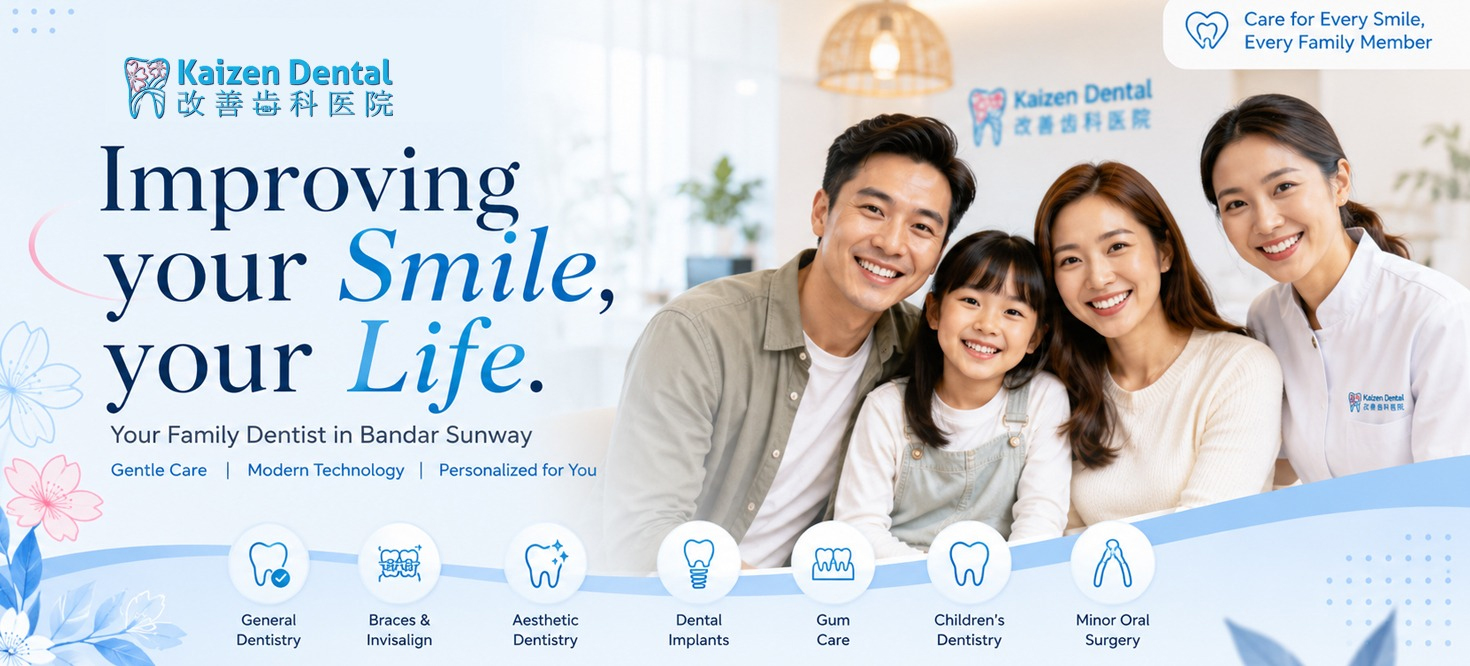
Choosing the Right Dental Clinic Near Me: A Local Guide for Families in Sunway Geo
Medically reviewed by Dr. Teh Jing Ju, Founder & Clinical Director, Kaizen Dental · Last updated: 12 August 2026
If typing “dental near me” into Google from Sunway Geo has left you juggling convenience, cost, and a lot of vague promises, this guide to choosing a dental clinic near me will cut through the noise. You will get a short, practical checklist to evaluate clinical credentials and family friendly services, a call script to confirm pricing and emergency policies, and the logistics that matter for working parents. Finally, a verifiable local example shows the checklist in action so you can decide whether to book or switch with confidence.
Why choosing the right dental clinic matters for families in Sunway Geo
Key point: Picking a dental clinic is not just about convenience – it shapes preventive care, emergency response, and how often your family ends up paying for avoidable work later. Continuity with a single family dental clinic builds a medical record that makes checkups faster, treatments more accurate, and recalls easier to manage for children and adults alike.
Sunway Geo and Subang Jaya are dense, commuter heavy neighbourhoods where parents juggle school runs, shifts, and traffic, and where local dental services range from solo practices to multi-chair family clinics. That makes accessibility important, but nearby dental care is only half the equation — it does not trump clinical capability. A clinic that is 10 minutes further but offers pediatric sedation, digital diagnostics, or reliable after hours contact will save time, stress, and cost when real problems occur.
Practical tradeoff: Choosing the cheapest clinic for routine extractions or crowns can be false economy if the clinic lacks proper diagnostics or restorative planning. Expect to pay more up front for thorough assessment and you will likely avoid repeat visits, failed restorations, or emergency referrals later.
Concrete example: A child bangs a front tooth at 8pm after weekday activities. A rushed search for “emergency dentist near me” at 8pm may surface a clinic that closed at 6pm and refers the family to a hospital emergency department. In contrast, a family dental clinic with an after hours line and a dentist experienced in pediatric trauma can triage over the phone, arrange urgent imaging, and often prevent a hospital transfer and long wait times.
Many people overvalue star ratings and glossy websites — the top result for “best dentist near me” is often the clinic with the best marketing, not the best clinical outcomes. In practice, look for specific signals instead: membership with professional bodies, published emergency policies, on site digital x rays and intraoral scanning, and visible evidence of pediatric experience. Verify registration with the Malaysian Dental Council, and look for professional memberships such as the Malaysian Dental Association, when in doubt.
What matters first for families
- Ask about emergency coverage: call the clinic and confirm an after hours contact or referral pathway
- Confirm child experience: ask whether dentists provide behaviour management or sedation for anxious children
- Request a written estimate for planned work: get a treatment plan that explains alternatives and follow up needs
Next consideration: After you shortlist, schedule a non treatment first visit to check tone, communication, and how the team handles children’s appointments. That one on site observation reveals more than reviews when deciding long term family care.
Credentials and clinical quality checks to verify
Start with registration: Confirm the dentist is listed with the Malaysian Dental Council and ask for the registration number. Membership in professional bodies or continuing education certificates matter, but the registration number is the baseline that proves legal standing to practise in Malaysia.
Check treatment specific credentials: For specialised services look for explicit credentials rather than vague claims. Examples to verify include certified Invisalign providers via the official Invisalign provider locator, endodontists who routinely use a dental microscope, and dentists with postgraduate training in paediatric dentistry or conscious sedation.
How to verify practical capabilities
| Credential or capability | How to confirm quickly | Why it matters |
|---|---|---|
| Dental registration | Request registration number and check with the Malaysian Dental Council or ask to see official documentation | Confirms legal right to practise and basic regulatory oversight |
| Invisalign certification | Look up the dentist on the Invisalign locator and ask for recent case photos or a treatment plan sample | Ensures the provider has training and real case experience with aligner workflows |
| Digital imaging and CBCT | Ask which models they use and whether scans are taken in-house or referred out | On site imaging speeds diagnosis and reduces the need for repeat visits; CBCT matters for complex endodontic and implant cases |
| Sterilisation and instrument tracking | Request a brief explanation of their sterilisation cycle, and whether they use autoclave indicators or instrument tracking | Reduces infection risk and shows operational discipline rather than ad hoc cleaning |
| Paediatric or sedation training | Ask for certificates or years of experience treating children and whether sedation is performed on site | Child behaviour management and safe sedation are skills you do not want to discover at the chairside |
Tradeoff to consider: High end equipment and specialist credentials raise costs but also reduce the chance of retreatment or emergency referrals. A small clinic that refers complex cases to a reliable specialist can be a valid choice if they manage continuity of care and transfer clinical records promptly.
Practical limitation: Certificates on a website can be staged photos. A better test is a short phone or email request for the dentist to describe a similar recent case, the timeline, and the expected follow up. If the staff cannot answer that, the clinic likely lacks hands on experience.
Concrete example: An adult needs a difficult root canal on a molar that has curved canals. A clinic that performs the procedure with CBCT planning and a dental microscope can often complete treatment in fewer visits and with better long term prognosis. A clinic without those capabilities may refer out or perform the work with higher risk of missed canals and retreatment.
When you call a clinic ask three specific things – registration number, whether the procedure is done in-house or referred, and how they handle follow up if complications occur.
Services families should prioritize when searching for a dental clinic near me
Start with services that reduce repeat visits. For busy families the objective is not the fanciest treatment but predictable care that keeps everyone out of the emergency room. Prioritise services that prevent problems, resolve common issues in one or two visits, and hand off complex care cleanly when needed.
Top services to look for (and why they matter)
- Preventive care and reliable recall: regular scaling, fluoride programs, and an organised recall system avoid decay in children and reduce restorative bills for adults.
- Pediatric dentistry experience: look for behaviour management, child‑sized instruments, and staff comfortable with anxious kids rather than a generic adult clinic trying to improvise. A search for a pediatric dentist nearby should surface those specifics, not just stock photos of smiling children.
- Emergency and urgent care pathways: an after hours contact, same‑day slots or fast triage prevents minor trauma from becoming a hospital visit.
- On‑site digital diagnostics: intraoral scanning and digital x rays speed diagnosis and let the dentist show you the problem on screen during a single appointment.
- Certified orthodontic options: if Invisalign or clear aligners interest your teens, confirm the clinic lists certified providers and workflow (scans, attachments, follow ups) — not every result for “orthodontist near me” is a certified aligner provider.
- Cosmetic dentistry done conservatively: whitening, veneers and bonding are common family requests — when comparing results for “cosmetic dentistry near me”, prioritise clinics that show real before-and-after cases over heavily edited marketing photos.
- Restorative and sedation capability: crowns, accurate shade matching, and safe sedation for anxious patients keep complex work under one roof when appropriate.
- Transparent pricing and payment options: clinics that provide written estimates and instalment plans cut the friction when multiple family members need treatment.
Tradeoff to accept: a clinic that checks all the boxes will usually cost more than a barebones neighbourhood office. That extra cost is a deliberate trade: fewer compromised restorations, fewer referrals, and less disruption to family schedules. If budget matters, choose a clinic that refers reliably and transfers records promptly rather than one that overpromises in‑house.
Concrete example: A working parent with two schoolchildren and a teen seeking straightening will save time by visiting a clinic offering preventive recall, paediatric visits, and certified clear‑aligner treatment. Instead of juggling three different appointments across town, coordinated care lets the provider sequence cleanings, monitor child decay risk, and start an Invisalign workflow with digital scans during one visit. See how clinics document such workflows before booking — for instance, review provider pages like Kaizen Dental Clinic Invisalign to confirm certification and process steps.
Prioritise services that reduce the number of separate visits and the chance of emergency referrals.
Next consideration: when you narrow your shortlist, call and confirm two things only: whether the specific service you need is performed in‑house and whether they provide a written estimate — those answers reveal whether the clinic is set up for family care or just filling appointment slots.
Patient experience and care approach that matters to families
Key point: Families do not pick a dental clinic for ambience alone — they pick it for predictable, low‑stress visits that keep children cooperative and working adults on schedule. The care approach — how the team communicates, manages pain and anxiety, and coordinates follow up — determines whether you get one good visit or reliable long term care.
A common problem: clinics advertise gentle dentistry but run 10 minute slots and push quick turnover. That is a signal, not a promise. Practical solution: choose a clinic that openly schedules longer first visits for children or anxious patients, explains pain control options in plain language, and provides a clear aftercare plan. Longer chair time on the first visit is often the cheapest way to avoid sedation or repeated appointments later.
What to look for during a first visit
- Clear consent and options: dentist explains at least two treatment paths, expected discomfort, and estimated follow up rather than issuing a single recommendation.
- Visible pain control protocol: mention of topical gels, staged local anaesthesia, and non‑pharmacological strategies (distraction, rapport) rather than immediate talk of sedation.
- Child engagement techniques: use of behaviour management, age‑appropriate language, and parental involvement in the chair when needed.
- Aftercare and emergency clarity: staff give a printed or digital aftercare note and a designated emergency contact or WhatsApp line.
Tradeoff to weigh: truly gentle care requires time and staff training. That often raises fees or limits same‑day capacity. If budget or immediacy is the priority, pick a clinic that will refer complex patients reliably and transfer records promptly rather than one that promises in‑house comfort it cannot deliver.
Illustrative scenario: A mother brings an anxious 6 year old for a filling. At Clinic A the nurse rushes intake, the dentist asks standard questions and starts the procedure within 5 minutes; the child cries and the filling needs rework. At Clinic B the team spends 20 minutes building rapport, uses topical anaesthetic and a short distraction technique, and completes treatment in one sitting with less distress. In practice the modest extra time at Clinic B saves two repeat visits and reduces family stress.
Judgment: Online photos and polite receptionists matter little compared with process cues you can test quickly: phone the clinic and ask them to explain how they calm an anxious child, or request the exact steps they use for pain control. If staff answer with specifics and timelines, the clinic has a replicable approach rather than marketing language.
Good sign: the dentist shows intraoral photos or scans during the visit, explains two treatment options with recovery expectations, and schedules a follow up before you leave.
Cost transparency, payment options, and insurance considerations
Straight talk first: genuinely affordable dental care is about net cost across visits, not the lowest headline price — and price clarity is the gatekeeper. If a dental clinic near me will not provide a written estimate for a planned procedure or refuses to explain typical emergency fees up front, the clinic is adding avoidable financial risk to your family care.
Ask for an itemised estimate for each major line: consultation, digital x ray or scan, scaling, filling, crown, extraction, root canal, and aligner treatment . A single line price for Invisalign or crowns without a breakdown hides where costs may rise – for example additional visits, lab fees, or replacement aligners. Insist on written estimates by email or WhatsApp before booking.
Practical script to get a firm written quote
- Step 1: Tell reception which service you need and request a written estimate that lists each charge and likely follow ups.
- Step 2: Ask whether any fees are likely as add ons – e.g. sedation, night call, lab costs, or provisional crowns – and request approximate amounts.
- Step 3: Confirm payment methods accepted and ask if instalment plans or partnerships with payment providers are available for larger treatments like Invisalign.
- Step 4: If you have insurance or corporate cover, ask whether the clinic does direct billing or issues itemised invoices suitable for claim submission.
Tradeoff to evaluate: instalment plans spread cost but often extend the overall price through interest or admin fees. Clinics that offer zero interest instalments typically work with third party finance partners and require identity verification. If you prefer minimal total cost, pay up front where possible. If monthly cash flow matters, read the instalment contract for early repayment penalties and final total repayment amount.
Insurance reality check: many Malaysian plans reimburse outpatient dental care rather than pay clinics directly. Confirm whether the clinic can do direct billing to employer panels or private insurers and what documentation they provide – itemised receipt, treatment codes, and a short clinical narrative. Without those documents you will have to claim later and may face partial reimbursement.
Concrete example: A family books an initial consult and scan for a teen considering Invisalign. The clinic provides a written plan showing scan fee, aligner fee, monthly review visits, and a separate retention fee. The clinic also explains an instalment option with exact repayment terms. That transparency lets the family compare net cost versus another nearby dental office offering a lower headline price but no written breakdown.
A common mistake is assuming emergency care follows the same pricing rules as scheduled work. Ask specifically about after hours or urgent care charges and the expected response time. Clinics that are clear about night or weekend fees are more likely to have the logistics to actually support urgent phone triage and quick appointments.
Real reference points: As a guide to Malaysian private fees, Kaizen Dental publishes indicative ranges on its own site: wisdom tooth removal from about RM 250 for a simple extraction up to RM 2,500+ for impacted surgical cases, and Invisalign timelines from roughly 6-12 months for mild crowding to 18-24 months or longer for complex bite correction, with aligners worn 20-22 hours per day. Use published ranges like these to sanity check any quote you receive.
Key point: If a clinic will not itemise costs or explain how they handle insurance claims, treat that as a disqualifier for family care.
Next consideration: once you have two written estimates from local options found by searching dental clinic near me, compare the net cost, not only the headline price, and weigh that against convenience and the clinic’s ability to handle complications. The correct choice balances clear pricing with reliable clinical capability.
Location, hours, accessibility, and logistics for Sunway Geo families
Practical reality: for families in Sunway Geo, the closest dental clinic on the map can still be a bad choice if it has no parking, narrow access for strollers, or only daytime hours that clash with school and work schedules. Logistics decide whether an appointment is kept or skipped, and skipped appointments are where preventive care fails.
Local checks to run before you book
- Check travel time at the appointment hour: use live traffic on Google Maps rather than straight-line distance; 10 minutes off-peak can be 30+ minutes during rush hour.
- Confirm parking and drop-off: ask whether there is reserved or validated parking, a short-term drop-off zone, or motorcycle bays if that is how your family travels.
- Verify step-free access and stroller/wheelchair routes: elevators, ramps, and door widths matter for toddlers and elderly relatives more than glossy photos.
- Ask about precise opening slots: early morning (7:30–8:30), late evening, and weekend availability reduce missed appointments for working parents; confirm whether these are regular slots or occasional walk-ins — a “walk-in dental clinic near me” search is useful in a pinch, but scheduled recall beats ad-hoc visits for prevention
- Find the real after-hours policy: a listed after-hours contact is better than a voicemail—ask whether they triage by phone, offer Saturday emergency slots, or refer to a nearby hospital.
Tradeoff to consider: clinics that advertise late hours or 24-hour dentist near me often carry higher emergency call fees or outsource coverage to offsite providers. That provides convenience, but may not deliver the same continuity of care as a clinic that keeps regular, predictable extended hours with the treating dentist on call.
Illustrative scenario: picture a family with two young children who drive; Clinic A near Sunway Geo had no on-site parking and a narrow stair entrance. Clinic B, 6 minutes further, offered reserved parking, a ramp, and a pre-8am slot. The family switched to Clinic B because the small extra commute eliminated stroller lifts and allowed same-day school drop-offs without stress.
Accessibility detail people miss: wheelchair access is not just a ramp at reception. Check for an accessible restroom, treatment chair transfer space, and staff trained to assist. If a clinic cannot describe these specifics clearly over the phone, expect barriers on the day and plan for an alternative.
If you need evening or weekend appointments, confirm they are booked regularly (not only occasional) and ask whether the dentist who sees you is the same clinician you will see during normal hours.
One more practical tip: use the clinic contact page to test responsiveness. Send a WhatsApp or booking enquiry (many local dental offices use WhatsApp) and note response time and clarity. Fast, clear replies correlate with reliable appointment management and fewer last-minute cancellations. For booking details at a nearby example, see Kaizen Dental Clinic Contact .
Clinic comparison checklist and step by step decision process
Direct point: The fastest way to find a dentist your family can stay with is to stop collecting soft impressions and start collecting verifiable answers. Any dentist office nearby can look polished online. The right decision comes from a short checklist you can run through in a five‑minute call, followed by a simple scoring rule to break ties.
One‑page checklist (print or save on your phone)
- Clinical registration: Dentist registration number and at least one verifiable credential; ask to confirm the number and note it.
- In‑house capability: Is the procedure done on site or referred out? (digital x ray, intraoral scan, CBCT, microscope for root canals).
- Child readiness: Does the team schedule longer first visits for children and use behaviour management techniques?
- Emergency access: After‑hours phone, weekend slots, and typical response time (minutes/hours).
- Cost transparency: Request a written estimate by WhatsApp or email listing scan, lab, and follow up fees.
- Appointment logistics: Early/late slots, parking/drop‑off, stroller access, and whether the same dentist sees you each visit.
- Communication test: Response time to a booking enquiry and clarity of answers (aim for same day, clear short answers).
Practical insight: A clinic that answers the clinical capability and cost questions precisely on a first call is usually operationally reliable. If answers are vague or deferred repeatedly, that indicates either process gaps or a front desk that cannot access clinical information—both are red flags for family care.
Step‑by‑step decision flow (use this every time)
- Shortlist three clinics: Use the map results from searches like “dental near me” or “dental office in my area” and pick three within acceptable travel time.
- Five‑minute verification call: Use this script: I need to confirm (1) dentist registration number, (2) is X procedure done in‑house, and (3) can you send a written estimate for that procedure by WhatsApp or email?
- Score each clinic quickly: Apply simple weights (clinical capability 40%, emergency/hours 20%, patient experience 15%, cost transparency 15%, logistics 10%).
- Book a non‑treatment consult: Watch how they run the first visit—do they allow time, show images/scans, and give written follow up?
- Decide within two visits: Prefer continuity; if the first consult raises unanswered clinical questions, treat that as a fail and move to your second choice.
Trade‑off to accept: If a clinic ticks most boxes but costs more, weigh the extra fee against the risk of repeat work or emergency referrals. Paying a premium for proven diagnostics and reliable emergency triage often saves time and money across a family lifetime.
Illustrative scenario: imagine a working couple comparing three options for a recurring crown problem. Clinic A was closest and cheap but could not provide CBCT or a microscope; Clinic B sent contradictory WhatsApp quotes; Clinic C (10 minutes further) provided registration numbers, in‑house CBCT, a written cost breakdown same day, and a Saturday slot. Clinic C is the rational pick: proven diagnostics and clear written pricing are what keep a crown repair from turning into repeated emergency visits.
When you want a local example to test this workflow, send a short WhatsApp enquiry to Kaizen Dental Clinic Contact asking for registration numbers and a written estimate for your needed service. Their response will demonstrate the operational standards you should expect from any clinic you choose.
Kaizen Dental Clinic Sunway Geo: how Kaizen meets the family checklist and practical next steps
Direct point: Kaizen Dental Clinic Sunway Geo covers the specific, practical items families need rather than selling vague comfort. Their on‑site capabilities, communication channels, and visible pediatric protocols match the operational tests you should run during a five‑minute call.
Clinical evidence: Kaizen Dental’s Invisalign credentials are published and dated: Platinum Provider in 2019 and 2020, Platinum Elite Provider in 2021, and Diamond+ Provider (Top 1%) in 2022. The team of five dental surgeons is profiled by name on the Our Doctors page — including Dr. Calista Gan, a Platinum Invisalign Provider with over 15 years in dentistry, and Dr. Chong Wen Hao, a certified Invisalign and Angel Aligner provider. Invisalign consultations use digital scans, photos and X-rays where needed before any plan is finalised. Verify individual registration numbers during your call, and ask which clinician will handle follow ups for each family member.
Family‑friendly operations: Kaizen runs a dedicated children’s programme, Little Kaizen, covering both children and pregnant mothers, and for anxious patients the team plans extra explanation time, agrees a stop signal before treatment begins, and starts with conversation and examination rather than pressure. The clinic is reachable by phone and WhatsApp during opening hours — Monday to Friday 9:00am to 8:00pm and Saturday 9:00am to 5:00pm. One tradeoff to know: true 24‑hour surgical emergencies still require hospital referral, so ask about the escalation pathway for complex trauma or oral surgery.
Practical tradeoff: Expect slightly higher fees than a minimal neighbourhood office when a clinic runs in‑house diagnostics and certified orthodontic workflows. In practice that extra cost often prevents repeat visits and emergency transfers — but if your priority is lowest upfront cost, confirm the clinic’s referral partners and record transfer process before committing.
Real cases the clinic publishes: One patient in her late 40s assumed she was too old and too crowded for Invisalign; digital scans and a treatment simulation showed what was realistically achievable, and she completed treatment. Another had avoided dental care for over a decade because of severe anxiety — the team built trust gradually, agreed a stop signal, avoided unnecessary treatment at the start, and moved at the patient’s pace until routine six‑month checkups became comfortable. Both reflect the assessment‑first, no‑pressure approach families should look for.
Practical next steps to test Kaizen quickly
- Call and confirm exactly three things: the treating dentist’s registration number, whether the specific procedure is performed in‑house, and the method they use for urgent after‑hours triage.
- Request a written estimate by WhatsApp or email showing scan, lab and follow up fees so you can compare net cost across clinics.
- Bring these to your first visit: ID, any prior x‑rays, insurance or employer scheme details, and a list of medications — ask the dentist to point out two treatment paths and expected timelines.
- Book through the clinic contact page to test responsiveness: use Kaizen Dental Clinic Contact and note turnaround time and clarity of the reply.
Frequently asked questions about finding dental care in Sunway Geo
What makes a good family dental clinic?
A good family dental clinic combines four things: a registered dentist whose MDC number you can verify, in-house diagnostics such as digital x rays, genuine experience treating children, and transparent written pricing. Location matters less than most people assume – capability and continuity are what keep long term costs down.
How do I find a dentist office nearby that suits my family?
The fastest way to find a dentist you can stay with is verification, not browsing. Shortlist three clinics from your map results, then call each with three questions: registration number, whether your treatment is done in-house, and whether they send written estimates. Local dental services vary widely behind similar-looking websites.
Is the closest dental clinic always the right choice?
No. The closest dental clinic wins only when capability is equal. Searching for a dental office in my area should produce a shortlist, not an automatic winner – nearby dental care that is ten minutes further but handles children, diagnostics, and emergencies properly usually costs less over a family lifetime.
What should I do when I need an emergency dentist near me?
Call your regular clinic first – many run phone or WhatsApp triage even after hours. If nobody answers, a walk-in dental clinic near me search can locate same-day care, but confirm fees before travelling; after hours charges differ from scheduled visits, and severe trauma may still need a hospital.
How can I get affordable dental care without cutting corners?
Compare net cost, not headline price. Genuinely affordable dental care comes from itemised written estimates, instalment terms you have actually read, and preventive recall that avoids expensive repeat work. A cheap filling that fails is more expensive than a properly diagnosed one done once.
How do I pick the best dentist near me for young children?
Ignore the phrase best dentist near me in advertising and look for evidence instead: longer first visits for children, behaviour management training, and staff who can explain their pain control steps over the phone. A pediatric dentist nearby with those signals will outperform a higher-rated adult-focused clinic.
Should I look for an orthodontist near me for Invisalign?
Not necessarily. Invisalign is provided both by orthodontists and by general dentists certified through the official provider programme. Whether you choose an orthodontist near me or a certified family clinic, ask to see recent case photos, the digital scan workflow, and a written fee breakdown including retention.
How do I compare clinics for cosmetic dentistry near me?
Ask every provider of cosmetic dentistry near me for unedited before-and-after photos of their own cases, the materials they use, and the expected lifespan of the result. Conservative treatment plans that preserve tooth structure are a better sign of quality than aggressive discounting or heavily filtered marketing images.